

How Prizes and Payouts Work in Color Games
Color Game prizes are determined by how many dice match the color you selected and the payout table attached to that result. A single match, double match and triple match can pay very differently, so reading the odds correctly is essential before putting PHP on any color.
Color Game Payout Basics
A standard Color Game round is built around three colored dice. Before the countdown closes, you choose one or more colors and decide how much PHP to place on each selection. Once the dice settle, your payout depends on whether your chosen color appears once, twice or three times.
The part that causes confusion is that Color Game does not have one universal prize table. Traditional versions often use a straightforward 1:1, 2:1 and 3:1 structure. Some online versions change the upper payouts considerably. JILI Color Game, for example, can use a much larger reward for three matching dice.
That difference matters. A player who assumes every triple match pays 3:1 could calculate a completely different result from the amount actually credited.
Prize, Payout and Total Return
Three figures should be kept separate:
- Stake: The amount placed on the color.
- Winnings: The prize generated by the payout ratio.
- Total return: The amount credited after settlement, including the returned stake when applicable.
Suppose PHP 100 is placed at 2:1. The winning portion is PHP 200. If the original PHP 100 stake is also returned, the final amount credited becomes PHP 300.
Do not automatically treat “2x,” “2:1” and “PHP 200 return” as identical descriptions. The app plus777 or game interface can label payouts differently, so the displayed paytable remains the final reference.
Color Game Prizes by Number of Matches
The three dice make payout calculations more interesting than a simple correct-or-wrong color prediction. The same PHP 100 selection can produce very different prizes depending on how often that color appears.

Color Game Prizes by Number of Matches
One Matching Die
Imagine putting PHP 100 on Red. The result lands:
Red – Blue – Yellow
Red appears once. Under a 1:1 single-match payout, the winning amount is PHP 100.
PHP 100 Single-Match Example
- Stake on Red: PHP 100
- Matching dice: 1
- Payout rate: 1:1
- Winnings: PHP 100
- Possible total credited amount: PHP 200 when the original stake is returned
A single match is the most common winning situation for one selected color, which is why its reward is normally the smallest of the three match levels.
Two Matching Dice
Now consider:
Red – Red – Blue
Red appears twice. A two-match result receives the payout assigned to the double rather than two separate single-match prizes.
For a JILI-style table using 1:2 for two matching dice, PHP 100 produces PHP 200 in winnings.
PHP 100 Double-Match Example
The calculation is simple:
PHP 100 × 2 = PHP 200
If settlement returns the PHP 100 stake separately, the total credited amount would be PHP 300.
The distinction is useful when comparing your wallet balance with the number shown beside the payout multiplier. A displayed prize may describe profit rather than the entire amount entering the balance.
Three Matching Dice
A triple occurs when all three dice show the selected color:
Red – Red – Red
This is where Color Game versions can separate sharply. A traditional table may award around 3:1, while JILI Color Game can attach a substantially higher 1:9 payout to a three-match result.
PHP 100 Triple-Match Example
At 1:9:
PHP 100 × 9 = PHP 900
If the stake is returned in addition to those winnings, the total credit would be PHP 1,000.
A triple therefore should never be calculated from memory alone. Check the current table first, especially when moving between different providers.
PLUS777 Color Game Prize Structure
For players using PLUS777, Color Game can be understood more clearly by separating the ordinary match payouts from additional JILI bonus mechanics. The brand only needs to provide the game environment; the actual mathematics of a JILI round comes from the provider’s rules and current paytable.
JILI Color Game Payout Levels
A commonly published JILI Color Game structure uses:
- One matching die: 1:1
- Two matching dice: 1:2
- Three matching dice: 1:9
This creates a deliberate jump between the double and triple outcomes. Moving from two matching dice to three does not simply add another unit of payout. The triple carries a much larger prize because that exact result occurs far less often.
Before confirming a wager, look at the payout figures shown inside the game itself. Provider updates, special versions or bonus modes can change how particular outcomes are rewarded.
Base Prizes and Bonus Multipliers
JILI Color Game can also include bonus features linked to repeated colors. These should not be confused with the ordinary match payout.
A normal two-color or three-color match follows its listed base rule. A special multiplier or jackpot condition is an additional mechanic with its own requirements.
Triple Green Jackpot
Three Green dice can be associated with a special jackpot condition in JILI Color Game. This result should be treated separately from an ordinary three-match calculation.
A triple-color payout tells you how a standard matching result is rewarded. A jackpot depends on specific qualifying conditions and may follow a different prize calculation entirely. Never assume every three-Green result automatically produces the same jackpot amount without checking the active rules.
Multi-Color Bets and Combined Payouts
Color Game does not require you to place everything on one selection. Several colors can be backed in the same round, but each wager should be treated as its own position.
Suppose you place:
- PHP 100 on Red
- PHP 100 on Blue
Your total amount committed is PHP 200.
The dice then show:
Red – Blue – Blue
Red has one match, while Blue has two. Both selections can qualify according to their respective payout levels.
Separate Settlement for Each Color
Using 1:1 for Red and 1:2 for Blue:
- Red winnings: PHP 100
- Blue winnings: PHP 200
- Combined winnings: PHP 300
The original stakes and the way they are returned must then be accounted for according to the game rules.
This is more accurate than looking at the round and simply saying, “Two of my colors won.”
Gross Winnings Versus Net Result
When several colors are selected, the size of a winning payout can look larger than the actual profit.
A useful calculation is:
- Add every wager placed during the round.
- Calculate the payout for each winning color separately.
- Add the winning returns.
- Subtract the total amount committed where necessary to determine the net result.
That final figure gives a clearer picture of how the round actually affected the balance.
Probability Behind Three Color Dice
The payout ladder makes more sense once the three-dice probability is considered.
Assume each die has six equally likely colors and the dice behave independently. For one specific selected color, there are 216 possible three-dice combinations.
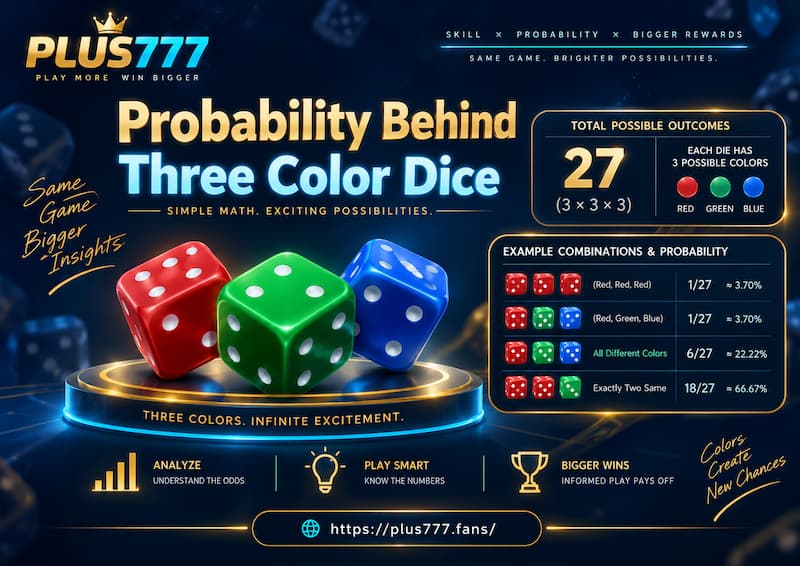
Probability Behind Three Color Dice
The approximate probabilities are:
- No matching die: 125/216, or 57.87%
- Exactly one match: 75/216, or 34.72%
- Exactly two matches: 15/216, or 6.94%
- Exactly three matches: 1/216, or 0.46%
A triple is therefore much less common than a single match. Larger rewards attached to three matching dice reflect that lower frequency.
Payout Odds Are Not Outcome Predictions
A 1:9 payout does not mean the triple should occur once every nine rounds. The number describes the reward, not the probability of the result.
Likewise, seeing Red miss for several rounds does not make Red “due.” If each roll is independently generated, previous dice results do not increase the chance of a particular color appearing next.
Color Game Paytables Can Differ
The name Color Game covers several related formats rather than one fixed ruleset.
Traditional fair-style games may use one payout table. JILI can use another. A different provider may introduce combination wagers, special dice, bonus multipliers or progressive prizes.
For platform-level payout limits or settlement restrictions, check the current terms and conditions alongside the provider’s paytable.
Provider Rules Come First
Before placing PHP on a round, check:
- The payout for one matching die
- The payout for two matching dice
- The payout for three matching dice
- Whether the displayed multiplier includes the original stake
- Any jackpot or bonus conditions
- Minimum and maximum wager limits
- Maximum prize rules, if applicable
Do not carry a payout table from one Color Game into another and assume the mathematics will be identical.
Reading a Color Game Payout Before Betting
A few seconds spent reading the table can prevent most payout misunderstandings.
Four Figures to Check
Bet Amount
Confirm how much PHP is being committed to each color. Multiple selections mean multiple separate stakes.
Match Multiplier
Check the exact reward for one, two and three matching dice rather than assuming the multiplier rises evenly.
Stake Return
Determine whether the figure shown represents winnings only or the full settlement including your original wager.
Special Prize Conditions
Read jackpot, bonus multiplier and maximum-win conditions separately from normal color-match payouts.
Color Game becomes much easier to calculate once these figures are kept separate. The dice decide how many times your color appears; the active paytable decides what that result is worth. When those two pieces are read correctly, even multi-color rounds and larger triple-match prizes can be worked out without guesswork.