

Fishing at Plus777: Games, Providers, Controls & Play
Fishing at Plus777 turns arcade-style fish shooting into a lobby of provider-led games with different targets, cannons, bosses, multipliers, and bonus features. Choosing well starts with understanding the shooting cost, game pace, and mechanics before chasing the biggest creature on the screen.
Fishing at Plus777: Inside the Lobby
Fishing has its own place in Plus777 game lobby alongside Hot, Slot, Mini Games, Live, Cards, and Sports. Selecting it brings up dedicated provider choices rather than throwing every fish-shooting title into one crowded list.
The visible lineup includes JILI Fishing, FC Fishing, JDB Fishing, YGR Fishing, and YellowBat Fishing, with additional games available through the Expand option. That separation is useful because Fishing games can feel surprisingly different even though the basic idea is similar.
One provider may favor fast shooting and frequent special effects. Another may build the action around bosses, weapon charging, bonus wheels, or multiplayer rooms. The artwork changes too, but that is usually the least important difference.
Before settling on a game, it makes more sense to check:
- The starting cannon or bullet cost
- How clearly target values are displayed
- Whether manual aiming feels comfortable
- Available lock-on or automatic shooting controls
- Boss and special-creature mechanics
- Bonus weapons and how they are activated
- The speed at which the screen fills with targets
A bright lobby tile can get attention, but the controls and cost structure decide whether a Fishing session actually feels comfortable.
How Fishing Games Work
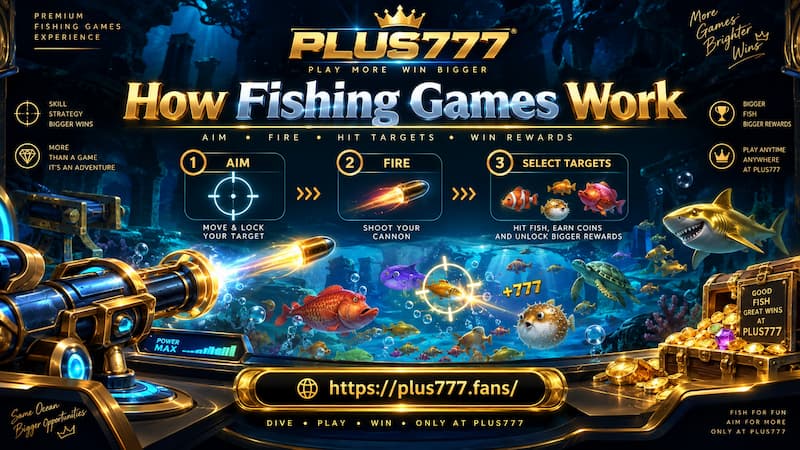
Fishing is closer to an arcade shooting game than a traditional slot game. Fish, sea creatures, monsters, or themed bosses travel across the screen while the player aims a cannon and fires at selected targets.
How Fishing Games Work
Each shot uses a chosen stake. When a target is successfully captured, the game calculates a reward according to its rules, target value, multiplier, or active feature.
That creates one important difference from spinning reels: The player controls how often shots are fired.
Aim, Fire and Select Targets
The screen rarely stays still. Small fish may cross quickly in groups while larger creatures remain visible longer or enter during special sequences. Some games add target-lock functions that help keep the cannon focused on one creature.
Large targets are visually tempting, especially when a large multiplier appears beside them. That number should not be mistaken for a promise that the target will fall within a few shots.
A target multiplier also should not be confused with theoretical payout, which describes long-run game return rather than the value attached to one successful capture.
A high-value target tells you what may be returned if it is captured. It does not tell you exactly how many shots the capture will require.
That distinction becomes especially important during boss fights.
Cannon Level and Cost Per Shot
The cannon setting deserves more attention than the animation around it. Every bullet can represent another wager, and Fishing can consume a balance quickly when the fire button is held down.
Consider a simple example. If a fictional game is set to ₱5 per shot, firing once costs ₱5. Twenty rapid shots would put ₱100 into the action. At ₱20 per shot, those same twenty shots would total ₱400.
The actual stake options differ by game, but the principle stays the same.
Increasing the cannon value also should not automatically be treated as a universal “stronger bullet equals easier capture” system. Individual Fishing games handle shooting power and capture mechanics differently. Check the rules before assuming a higher stake changes anything beyond the amount being wagered.
Comparing Plus777 Fishing Providers
Provider names matter more in Fishing than they might initially appear. They can signal different control styles, visual pacing, boss systems, weapons, and bonus structures.
| Provider | Useful Details to Check |
| JILI Fishing | Target functions, boss mechanics, bonus wheels and special weapons |
| FC Fishing | Cannon controls, shooting pace and target-value presentation |
| JDB Fishing | Multiplayer structure, bonus bullets, special cannons and room options |
| YGR Fishing | Volatility information, boss encounters and weapon systems |
| YellowBat Fishing | Game rules, available controls and target reward structure |
JILI provides a good example of how varied one Fishing catalog can become. Jackpot Fishing includes target and lockdown functions together with a Jackpot Wheel, while Mega Fishing adds weapons such as torpedoes and a railgun.
JDB’s Cai Shen Fishing takes another route, combining multiplayer rooms with features such as free bullets, a Fortune Wheel and special weapon mechanics.
YGR also varies individual Fishing titles rather than applying one formula to everything. Chill Fishing, for example, lists medium volatility and includes Neptune’s Trident, while Captain Fishing is listed as high volatility and uses mechanics such as nuclear bombs and an accumulating attack-power system.
The useful comparison is therefore not simply “Which provider is best?” It is which Fishing style fits the intended session.
Reading Fish Values, Multipliers and Bosses
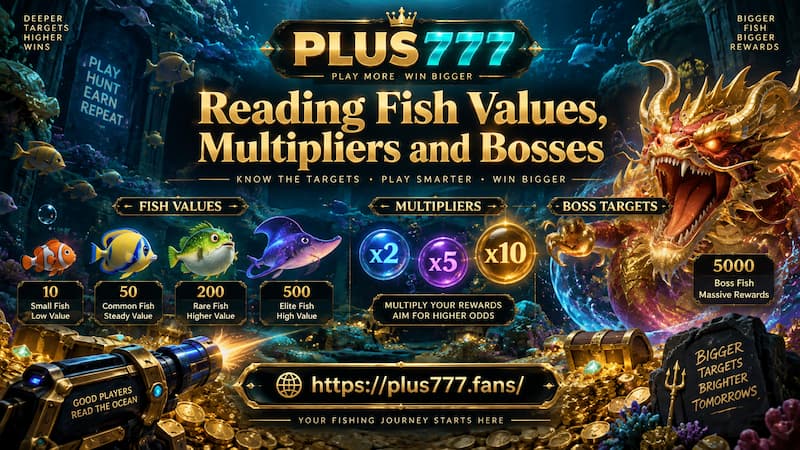
Fishing screens deliberately draw attention toward the largest targets. Dragons, sharks, sea kings, giant octopuses and other bosses often dominate the display, while smaller fish pass underneath almost unnoticed.
The better habit is to read the reward structure before deciding what deserves repeated shots.
Reading Fish Values, Multipliers and Bosses
Standard Targets
Ordinary fish normally form the constant traffic across the screen. They can be easier to track and may suit someone who prefers steady manual aiming rather than spending most of a session following bosses.
Multiplier Targets
A creature marked 10x, 50x or 100x may represent a reward calculated from the active bet if successfully captured. Exact calculations vary, so the game’s information panel should settle the question rather than assumptions carried over from another provider.
Boss and Special Targets
Bosses may carry much larger potential values or trigger another feature. Some Fishing games also introduce:
- Random multipliers
- Bonus wheels
- Jackpot events
- Special attack modes
- Full-screen weapons
- Energy meters
- Free bullets
- Secondary bonus rounds
One trap is continuing to fire simply because many bullets have already been spent on the same target. Unless the rules describe persistent health or accumulated progress, previous unsuccessful shots should not be treated as proof that the next one is “due.”
Special Weapons Change the Rhythm
Special weapons are where Fishing moves furthest away from simple point-and-shoot play.
Depending on the game, a player may encounter laser cannons, railguns, torpedoes, bombs, target locks, area attacks or screen-clearing weapons. Some are collected during normal shooting, while others appear after energy has accumulated or a particular target has been captured.
Their value is not only the possibility of a larger reward. They also change how targets can be approached.
A lock-on feature can reduce the effort of following a moving creature. A full-screen attack may hit several targets at once. An energy weapon can turn ordinary shooting into a build-up toward a much larger attack.
More features do not automatically make a Fishing game better, though. Screens full of explosions, meters, bosses and automatic fire can make it surprisingly difficult to notice how quickly the balance is changing.
For a first session with an unfamiliar title, understanding one feature at a time is usually more useful than activating everything available.
Choosing a Fishing Game for the Session
Not every Fishing session needs the same type of game. The better choice depends on pace, budget and how much mechanical complexity feels enjoyable.
For Short, Controlled Play
A simpler Fishing title can be easier to manage when the aim is a brief session. Useful characteristics include:
- Clear target values
- Comfortable manual aiming
- A modest starting shot value
- Easy-to-read balance changes
- Fewer overlapping bonus systems
This makes it easier to tell exactly where the money is going instead of becoming absorbed by continuous firing.
For Feature-Heavy Fishing
Players who prefer more activity may naturally lean toward games with bosses, multiplayer rooms, accumulating weapons, jackpot events or bonus sequences.
These games can be more visually satisfying, particularly when a charged weapon finally clears part of a busy screen. They also demand more attention. A player may be following a boss while a bonus meter fills and several valuable targets enter at the same time.
The best fit is the game where those features remain understandable rather than merely spectacular.
Controlling the Cost of Every Shot
Fishing can feel inexpensive because the amount attached to one bullet may look small. The real spending rate comes from stake × firing frequency.
Automatic or rapid firing makes that especially noticeable.
Before starting, four limits are useful:
- Set the total session budget. Decide the maximum Peso amount available before the first shot.
- Choose the normal cannon level. This becomes the default rather than constantly changing the stake.
- Set a maximum cannon level. A large boss entering the screen should not automatically trigger an uncontrolled jump in shot value.
- Choose an exit point. Ending the session should be a decision made before frustration or excitement starts changing the plan.
A missed target does not create a debt that the game is required to repay. Likewise, increasing the stake after several misses does not recover those shots unless the later result happens to cover them.
Keeping that distinction clear makes Fishing much easier to read as a wagering game rather than only an arcade animation.