

What Theoretical Payout Means in Casino Games
Theoretical Payout is the long-term return built into a casino game’s mathematics. It helps explain how wagered money is expected to flow back as prizes over extensive play, how games can be compared, and why the result of one session may look nothing like the published percentage.
Theoretical Payout and RTP
Theoretical Payout is commonly expressed as Return to Player, or RTP. In Philippine gaming regulation, PAGCOR defines RTP as the theoretical value of prizes awarded by a game as a percentage of all bets made over a large volume of gameplay.
Suppose a slot game has a theoretical payout of 96%. That number does not mean every PHP 100 wager should return PHP 96. It also does not mean a player who wagers PHP 1,000 during an evening should finish with PHP 960.
Instead, 96% describes the game’s mathematical return across a very large sample of wagering activity.
A PHP 1 Million Example
Imagine PHP 1,000,000 in total turnover on a game designed with 96% RTP. Its mathematical model targets approximately PHP 960,000 being returned through prizes across that turnover, leaving the remaining 4% as the game’s theoretical advantage.
The calculation describes aggregate wagering, not an individual bankroll.
Theoretical Payout is a mathematical expectation, not a repayment schedule for money wagered.
That distinction removes one of the most common misunderstandings around RTP.
How Theoretical Payout Is Calculated
A casino game reaches its theoretical payout through probability and prize values. Every possible result contributes something to the overall expected return.
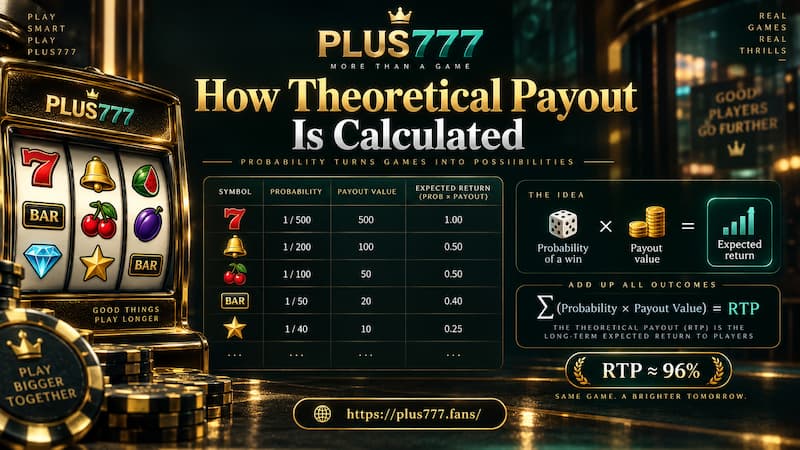
How Theoretical Payout Is Calculated
At a simplified level:
Probability of an outcome × value returned by that outcome = its contribution to expected return.
A game developer then combines the expected values of all possible results, including ordinary prizes, bonus features and other qualifying rewards.
Probability and Paytable Work Together
Consider a very simple imaginary game with several winning outcomes. A common prize might appear frequently but pay only a small amount. A rare event could pay hundreds or thousands of times the stake.
Neither prize size nor win frequency alone determines RTP. The complete probability model does.
That is why two slots can both advertise 96% theoretical payout while having completely different paytables and playing rhythms.
Theoretical RTP and Actual RTP
Theoretical RTP is designed into the game. Actual RTP is measured from real gameplay.
The basic actual RTP calculation is:
Total prizes paid ÷ total turnover × 100
For example, if a game records PHP 10 million in turnover and PHP 9.4 million in prizes during a measured period, its actual RTP for that period is 94%.
That does not automatically mean a game designed at 96% is malfunctioning. Shorter samples can move noticeably above or below the theoretical percentage. Current UK Gambling Commission monitoring guidance notes that this tolerance narrows as the volume of play increases, with actual RTP expected to move closer to theoretical RTP over sufficiently large samples.
House Edge and Theoretical Payout
RTP describes expected return to wagers. House edge describes the mathematical advantage retained by the casino side of a house-banked game.
For a straightforward game model, the two can be viewed from opposite directions:
- 97% theoretical payout → about 3% theoretical house advantage
- 96% theoretical payout → about 4%
- 94% theoretical payout → about 6%
This relationship is useful for comparison, but table games deserve more care. The Gambling Commission describes house edge as the average mathematical advantage held by the casino in games such as roulette, blackjack and punto banco.
Table Game Rules Change the Number
One blackjack table cannot automatically be assigned the same expected return as another. Deck count, dealer rules, doubling conditions, surrender rules and player decisions can all affect the mathematics.
A useful example is blackjack switch house edge, which can change when dealer rules, blackjack treatment and other conditions differ.
Baccarat also contains different bets with different expected values. Roulette changes depending on wheel format and wager type.
So a headline such as “Blackjack has 99% RTP” is incomplete unless the rules and strategy assumptions behind the figure are known.
Volatility Changes How RTP Feels
Theoretical Payout explains how much value a game is designed to return over time. It does not explain how that value is distributed.

Volatility Changes How RTP Feels
Same RTP, Different Playing Patterns
Take two hypothetical slots, both set at 96% RTP.
Game A pays smaller prizes regularly. Game B produces long stretches with few meaningful returns but occasionally lands a much larger prize.
Their theoretical payout can be identical, yet playing PHP 20 per spin on each can produce dramatically different balance movements.
Regulatory monitoring guidance describes high-volatility games as tending toward larger, rarer prizes, while lower-volatility games are generally built around smaller, more frequent awards.
RTP, Volatility and Hit Frequency
These terms should not be blended together:
- RTP: The proportion of wagered value theoretically returned over extensive play.
- Volatility: How widely outcomes and prize values can swing.
- Hit frequency: How often a result classified as a win occurs.
A Winning Spin Can Still Lose Money
Hit frequency can also be deceptive.
Suppose a PHP 20 spin returns PHP 5. The game may technically record a prize event, but the player’s balance still falls by PHP 15.
A slot can therefore produce frequent winning animations without necessarily delivering a high theoretical payout or strong short-term results.
Theoretical Payout Across Casino Games
RTP is most familiar in slots, but the underlying concept extends well beyond reels.
Slots
For slots, theoretical payout is embedded in the game’s mathematical configuration. Reel probabilities, symbol values, free spins, multipliers and bonus mechanics can all contribute to the final percentage.
Some games may also exist in more than one RTP configuration. For that reason, the figure attached to the exact version being played is more useful than an RTP percentage copied from a general game review.
Table Games
Table games usually require more context because the expected return can change according to the bet or decisions being made.
Blackjack is the clearest example. A theoretical percentage based on mathematically strong play does not automatically represent the return produced by someone making very different decisions.
Regulatory standards acknowledge this issue. UK remote-gaming rules specify that where an element of skill affects a game, theoretical RTP may be calculated using an autoplay or recognised strategy.
Progressive Jackpots
Progressive jackpots add another wrinkle. Part of the mathematical return may be connected to an infrequent jackpot capable of reaching a very large value.
That can make the headline RTP look attractive while a meaningful portion of the return sits inside an event that occurs extremely rarely.
Base Game and Jackpot Return
For serious comparison, separating the base-game behaviour from the jackpot contribution gives a clearer picture. Regulatory monitoring guidance similarly treats progressive jackpot performance differently because large, infrequent jackpot awards create unusually high volatility.
Reading Theoretical Payout at PLUS777
When choosing a casino game at PLUS777, theoretical payout works best as a comparison tool rather than a prediction.
If RTP information is provided in the game rules, paytable or information menu, check the number attached to the exact game being opened. Do not assume that a percentage found for a similarly named version elsewhere is automatically identical.
For a Philippine player wagering in Peso, a useful comparison can include:
- Published theoretical payout
- Volatility or prize pattern
- Minimum and maximum PHP wager
- Paytable structure
- Bonus mechanics
- Progressive jackpot contribution
- Rules that influence expected return
A 96.5% game is not automatically a better personal fit than a 96% game. Someone using smaller PHP wagers and preferring steadier prize patterns may care just as much about volatility. The higher RTP still has the stronger long-run mathematical return when other conditions are equal, but it does not guarantee the smoother session.
Limits of Theoretical Payout
Theoretical Payout becomes useful once its limits are understood.
Short Sessions Can Be Far From RTP
A few dozen spins can finish far above 100% RTP after a large win. Another session can finish close to zero. Neither result changes the game’s designed percentage.
Even hundreds of rounds may be a tiny sample compared with the volume required for actual results to settle near a theoretical average. Gaming-machine guidance specifically describes RTP as an average over large numbers of games and notes that normal volatility causes typical sessions to vary from it.
Previous Results Do Not Create a Debt
On random games, a losing streak does not mean the next spin is “due” to win simply because the game has a 96% RTP.
Likewise, a large recent payout does not automatically mean the game now needs to recover money.
Each random outcome follows the probabilities defined by the game mechanics. Regulatory guidance on random gaming machines states that the chance of winning the current game is not altered by previous wins or losses.
Comparing Games With Theoretical Payout
Theoretical Payout is valuable because it turns an otherwise vague game description into a measurable mathematical reference.
Use it alongside the rest of the game information rather than treating RTP as a single ranking score.
A sensible comparison is simple: Check the theoretical return first, then look at volatility, paytable structure, wager size and special features. If two games are otherwise equivalent, the higher RTP carries the smaller long-term mathematical disadvantage.
But a percentage cannot tell you what will happen tonight.
That is the line worth remembering. Theoretical Payout explains how a casino game is designed to return wagered value across extensive play. It does not forecast the next spin, guarantee a particular PHP return or erase short-term variance. Used on those terms, RTP becomes a genuinely useful way to read the mathematics behind a game rather than just another percentage beside its name.