

How the House Edge Works in Blackjack Switch
Blackjack Switch House Edge comes from a clear trade: You can exchange cards between two hands, but several rules give part of that advantage back to the house. The aim is simple—show where the edge comes from, how large it is, and which rules can move it.
Blackjack Switch House Edge at a Glance
Under standard six-deck Las Vegas rules, with the dealer hitting soft 17 and a blackjack created by switching treated as ordinary 21, optimal play produces a house edge of about 0.58%. That equals a theoretical payout, or RTP, of roughly 99.42%.
The 0.58% figure is a benchmark, not a universal number. Deck count, soft-17 rules, and blackjack treatment can all change the return.
House edge also describes long-run expectation, not the result of one session. At 0.58%, every ₱10,000 wagered does not automatically mean a ₱58 loss. Short-term results can move far above or below the mathematical average.
House Edge and RTP
- House edge: 0.58%
- Theoretical RTP: About 99.42%
- Meaning: A long-run statistical expectation, not a guaranteed session result
A low edge is only useful if the strategy matches the exact rules being played.
The Rules Behind the Edge
Blackjack Switch would be unusually favorable if it simply added card swapping to ordinary blackjack. It does not. The switch is balanced by rules that are less generous than standard blackjack.

The Rules Behind the Edge
Switching Two Hands
Each round begins with two equal wagers and two hands. The second card of each hand can be exchanged before normal play continues.
For example:
- Hand one: 5-10
- Hand two: 10-6
- After switching: 5-6 and 10-10
Instead of 15 and 16, you now have 11 and 20. One decision has turned two awkward totals into a strong doubling candidate and a made hand.
This switching power is central to the Blackjack Switch House Edge. The house offsets it elsewhere.
Dealer 22 Push
The biggest counterweight is dealer 22. Under common Blackjack Switch rules, a dealer total of 22 pushes against any non-busted hand of 21 or less, while a natural player blackjack still beats dealer 22.
In regular blackjack, dealer 22 is a bust and surviving hands win. Here, many of those wins become ties. Under six-deck H17 assumptions, dealer 22 occurs about 7.35% of the time, often enough to affect hit, stand, double, and split decisions.
Push 22 Changes Basic Strategy
A marginal standing hand is less attractive when dealer 22 no longer produces an automatic win. Conventional blackjack basic strategy therefore cannot simply be reused without adjustment.
Even-Money Blackjack
A natural blackjack commonly pays 1:1 in Blackjack Switch rather than 3:2. A blackjack created by switching is usually treated as ordinary 21 instead of a natural blackjack.
That distinction matters. Creating A-10 through a switch may look perfect, but its payout and dealer-22 treatment can differ from a naturally dealt blackjack.
Rule Variations Change the House Edge
The Blackjack Switch House Edge should always be tied to a particular rule set. The commonly quoted 0.58% applies to the standard six-deck H17 model described above. Published rule adjustments show how quickly the number can move.
- Eight decks: About +0.02 percentage points
- Dealer stands on soft 17: About -0.30 percentage points
- Switched blackjack automatically wins: About -0.40 percentage points
- Natural blackjack automatically wins: About -0.21 percentage points
These are adjustments to the referenced rule set, not universal figures for every version.
H17 and S17
H17 means the dealer hits a soft 17, such as A-6. S17 means the dealer stands. Under otherwise comparable rules, S17 is more favorable to the player; published analysis estimates a reduction of roughly 0.30 percentage points in the house edge.
A small line in the rules can matter more than the game name itself.
Strategy Errors Have a Real Cost
Because every round begins with two hands, principles from multi-hand blackjack strategy can help with total exposure and hand-by-hand decision discipline, although the switching decision still requires variant-specific strategy.
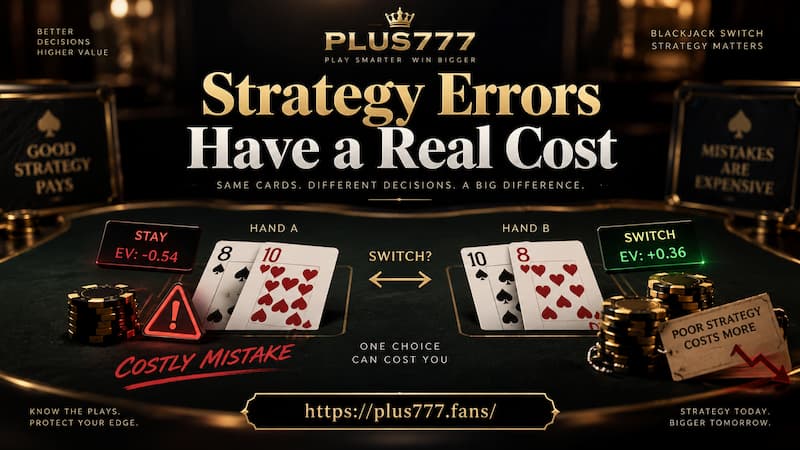
A common mistake is to create the strongest single hand while ignoring the second. Sometimes balancing both hands produces a higher combined expected value, especially once the dealer’s upcard enters the calculation.
Strategy Errors Have a Real Cost
Simple and Advanced Switching
Published strategy analysis estimates that Cindy Liu’s simple switching system costs about 0.17 percentage points versus optimal play. An advanced version cuts the estimated error cost to roughly 0.08 percentage points.
Those differences look tiny until they are compared with a base house edge of only 0.58%.
One published example compares keeping 12 plus soft 19 with switching to 8-8 plus soft 15 against dealer 6. Expected-value analysis favors the switched combination, even though the unswitched hands may look more comfortable at first glance.
In Blackjack Switch, the strongest-looking single hand is not always the best two-hand decision.
Playing Each Hand After the Switch
The practical order is:
- Compare the two possible hand combinations.
- Decide whether to switch.
- Apply Blackjack Switch basic strategy to each resulting hand.
- Check special rules for blackjack, doubling, splitting, and dealer 22.
What 0.58% Means in PHP
Suppose total original wagers across many rounds reach ₱10,000 and the applicable house edge is exactly 0.58%.
- ₱10,000 × 0.0058 = ₱58 theoretical expected loss
That does not mean the final result will be minus ₱58. Someone could finish ahead, behind, or close to even after the same betting volume. Variance dominates short samples.
At ₱100,000 in total action, the long-run mathematical expectation becomes ₱580 at the same 0.58% edge. The calculation scales smoothly; individual results do not.
Side Bets Have Their Own House Edge
The base Blackjack Switch House Edge does not apply to optional side bets. Each one has a separate paytable and expected return.
Super Match
Super Match uses the four initial player cards. With a published paytable of 1:1 for a pair, 5:1 for three of a kind, 8:1 for two pair, and 40:1 for four of a kind, the calculated house edge is about 2.55%.
That is more than four times the standard 0.58% base-game benchmark.
Push 22 Side Bet
A Push 22 side bet can pay 11:1 when the dealer finishes on exactly 22. Under six-deck H17 assumptions, published analysis gives it an expected value of about -11.76%, equivalent to an 11.76% house edge.
A low-edge base game can therefore sit beside a much higher-edge optional wager.
Checking Blackjack Switch at PLUS777
If Blackjack Switch appears at PLUS777, the first useful step is to open the game rules before choosing a stake. The name alone does not tell you the exact Blackjack Switch House Edge.
Rules to Check
Look for:
- Number of decks
- H17 or S17
- Natural blackjack payout
- Treatment of a switched A-10
- Dealer-22 rule
- Double-after-split rules
- Resplitting limits
- Side-bet paytables
- Game provider
If any of those differ from the standard six-deck Las Vegas model, do not automatically apply the 0.58% figure.
Keep Base Bets and Side Bets Separate
If Super Match, Push 22, or another optional wager is offered, treat it as a separate probability problem. A side bet can sit beside the main hands while carrying a house edge several times higher.
Blackjack Switch House Edge in Practice
Blackjack Switch House Edge is built around balance. The player gains the ability to repair two starting hands through switching; the house answers with even-money blackjack, dealer-22 pushes, and other rule adjustments.
For the standard six-deck H17 game with optimal strategy, about 0.58% is a useful benchmark. The better habit is to identify the exact rules first, separate side bets from the base game, and use strategy designed specifically for Blackjack Switch.
That turns the house-edge figure from a headline number into something genuinely useful.