

What Burning Means in Tongits
Burning in Tongits is the Sunog condition tied to reaching the end of a round without properly opening your hand through an exposed meld. Knowing when it applies matters because a low deadwood total alone may not save an unopened hand. Here is how the rule works and how to manage it in actual play.
Burning in Tongits and the Sunog Rule
Burning in Tongits sounds simple until you see it happen to a hand that looked strong. You may hold a clean set, carry only a few deadwood points, and feel ready for the final comparison. Then the round ends and the hand is marked Sunog because none of those combinations were actually exposed.
In traditional Tongits, a player is generally considered burned when the round ends before that player has opened by laying down a valid meld. The important word is exposed. A combination sitting privately in your hand does not usually count as opening.
That creates a clear distinction:
- A valid meld held in your hand is still concealed.
- A valid meld placed face-up on the table opens the hand.
- If the round ends before you open, Sunog may apply.
- Having fewer points than an opponent does not automatically cancel the burn condition.
What Counts as an Opened Hand
Opening normally requires placing a valid meld on the table during your turn.
Exposed Set
A set consists of three or four cards of the same rank. For example, 8♣, 8♦, and 8♥ form a valid three-card set.
Once that set is legally exposed, your hand is no longer unopened.
Exposed Run
A run contains at least three consecutive cards of the same suit, such as 5♠, 6♠, and 7♠.
Both sets and runs can remove the risk of remaining completely unopened, provided the meld follows the rules used in the game you are playing.
When Burning Happens
Burning in Tongits becomes relevant when the round finishes before you have exposed your first meld. The exact end condition can vary, but three situations deserve the most attention.
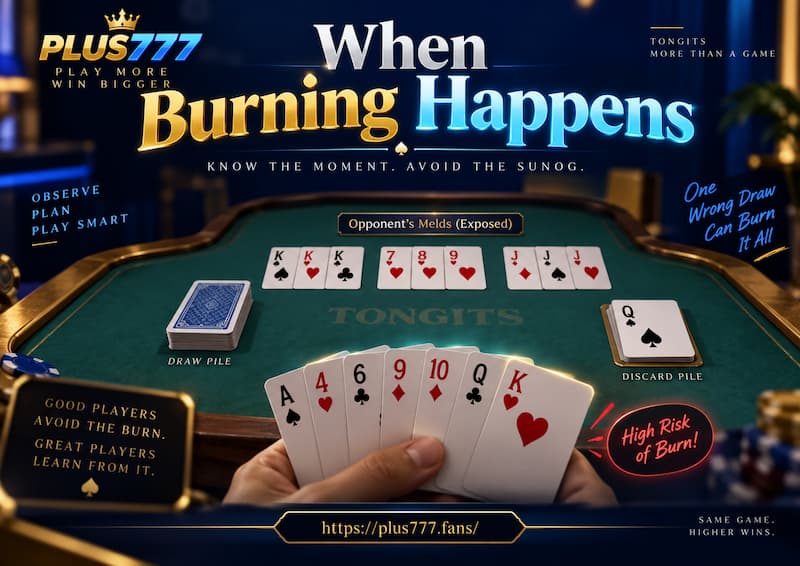
When Burning Happens
Another Player Declares Tongits
Suppose you are holding:
- 4♥, 5♥, 6♥
- K♣, K♦, K♠
- 3♣
It looks excellent. You have two complete melds and just one loose card.
But imagine you keep both combinations hidden because you want opponents to believe your hand is weaker than it is. Before your next turn, another player discards their final card and declares Tongits.
Your concealed combinations may never receive the chance to reach the table. Depending on the rule set, the hand can be treated as burned because you never opened.
The lesson is not that concealed melds are bad. Concealment has strategic value. The danger comes from protecting that secrecy for too long.
A Draw Ends the Round
An opened hand has options that an unopened hand may not have.
Under traditional Tongits rules, a player who has never opened generally cannot challenge a Draw. That means exposing a meld does more than prevent Sunog: It can also preserve your eligibility when the round moves into a deadwood comparison.
Consider two players near the end:
- Player A has 7 deadwood points but has never opened.
- Player B has 12 deadwood points and already exposed a run.
The instinct is to say Player A has the better hand because seven is lower than twelve. Burning changes that calculation. Eligibility comes first.
The Stock Runs Out
The final cards in the stock create a different kind of pressure. Early in the round, keeping a meld concealed may be worth the information advantage. With only a few draws remaining, that advantage shrinks quickly.
If the stock is nearly empty and you are still unopened, every turn becomes more valuable. Waiting one more cycle for the perfect discard can turn a playable hand into Sunog.
A strong concealed hand is only strong while there is still time to use it.
Burning Is Different From Losing on Points
One of the easiest mistakes is treating Burning in Tongits as another name for losing a round. They are not the same.
Burning Is Different From Losing on Points
A regular loss can happen after you have already opened. Your hand remains eligible, but another player finishes first or beats your deadwood total.
A burned hand has a different problem: You failed to satisfy the opening condition before the round ended.
Burned Hand vs Regular Loss
Imagine this finish:
Player A exposes a set of three Queens and ends with 14 deadwood points.
Player B holds a hidden 6♦, 7♦, 8♦ run and has only 5 deadwood points remaining.
Numerically, Player B looks better. Strategically, however, Player B never put a qualifying meld on the table.
If the applicable rules treat that hand as Sunog, the five-point total is no longer the deciding factor.
Low Deadwood Does Not Replace Opening
This is where experienced play differs from simply chasing the smallest possible hand value.
Reducing deadwood is important, but Tongits is not always a pure lowest-score race. Opening status can determine whether your score is even allowed into the comparison.
A player sitting on four deadwood points can therefore be in a worse position than someone with nine if the four-point hand is still unopened and the round is close to ending.
Sapaw and Burn Risk
Sapaw can create confusion because it lets you reduce cards without necessarily exposing your own original meld.
Adding to a Meld Is a Separate Action
If another player has already laid down 7♣, 8♣, and 9♣, you might be able to add 6♣ or 10♣. That is Sapaw: You are extending an existing meld.
It can be useful because the added card leaves your hand and reduces deadwood.
But Sapaw should not automatically be treated as identical to opening your own hand.
Reducing Deadwood Is Not Always Enough
Picture this situation: You have never exposed a set or run of your own, but you have attached two cards to melds belonging to other players. Your hand becomes much lighter, yet your opening status may still be unchanged under traditional rules.
When playing through plus777 app or another digital version, check how the particular game defines an opened hand. Automated versions handle these conditions for you, so misunderstanding the distinction between Sapaw and opening can lead to a result that feels surprising even though the game is following its programmed rules.
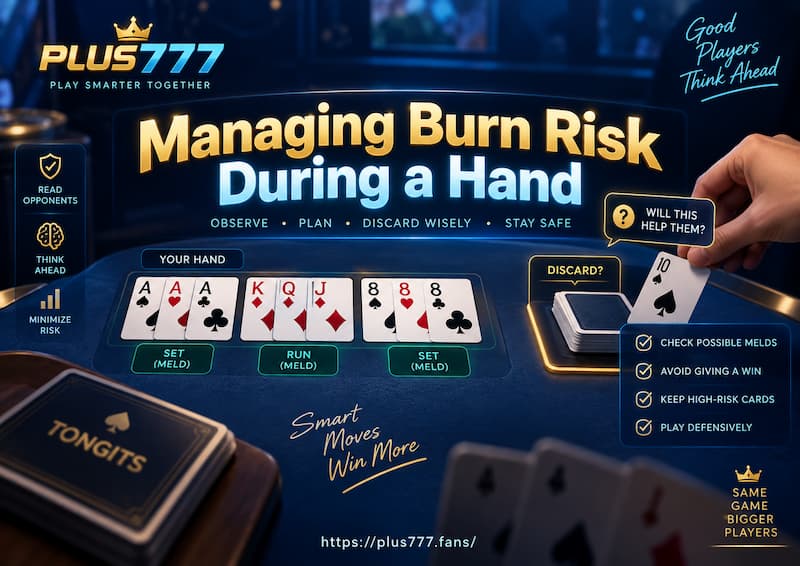
Managing Burn Risk During a Hand
Avoiding Sunog does not mean laying down your first meld the second you receive one. Doing so every time would make your play predictable and reveal useful information unnecessarily.
The stronger approach is to judge how much time remains.
Choose the Right Moment to Open
Early in the round, keeping 9♠, 10♠, and J♠ hidden may make sense. An opponent does not know whether you are building a run, holding pairs, or carrying several unrelated cards.
Later, secrecy becomes less valuable.
Consider opening when several warning signs appear together:
- The stock is getting noticeably short.
- An opponent has already exposed several melds.
- Another hand appears to be shedding cards quickly.
- You already hold a valid meld and have little to gain by waiting.
- A Draw could become possible before your next useful turn.
No single signal forces the decision. It is the combination that matters.
Watch the Stock, Not Just Your Cards
Many weaker Tongits decisions happen because all attention stays on the hand.
Your cards might improve with one perfect draw, but how many realistic draws are left?
If you need a 5♦ to complete a stronger sequence and the stock is almost exhausted, waiting may have poor practical value. Exposing the smaller valid meld you already possess can protect your position while still leaving room to improve the rest of the hand.
Do Not Wait for a Perfect Arrangement
Burning in Tongits often punishes perfectionism.
A player holds a legal three-card meld but keeps it concealed while hoping to transform it into a longer run or reorganize several cards at once. The hand looks increasingly elegant, yet the opportunity to open disappears when somebody else ends the round.
A legal opening does not need to represent your final hand structure. Sometimes its job is simply to keep you alive in the round.
Burning in Online Tongits at PLUS777
Digital Tongits removes arguments over whether a hand qualifies as burned because the result is processed automatically. When playing through PLUS777, an online casino brand serving the Philippines market, it is still useful to understand the logic before entering a PHP-based game.
Online versions may differ in scoring values, burn penalties, Draw procedures, or how certain actions affect eligibility. Traditional household rules are useful as a foundation, but the rules attached to the specific Tongits room should govern the session. If a platform-specific rule is unclear, check faq section before assuming a household rule applies.
Check the Burn Conditions Before Playing
Three details deserve a quick check:
Opening Requirement
Confirm exactly which action changes your status from unopened to opened.
Sapaw Treatment
Check whether adding cards to another meld affects eligibility or merely reduces deadwood.
Burn Settlement
Review how Sunog changes the result and whether an additional PHP settlement applies.
PLUS777 does not need to change the basic logic you use at the table: Track your opening status, watch the stock, and know when keeping information hidden has stopped being worth the risk.
Burning Rule in Practice
Burning in Tongits is ultimately an eligibility issue before it becomes a scoring issue. You can hold fewer deadwood points, better combinations, or a hand one card away from Tongits and still be vulnerable if nothing has been exposed.
The best decisions balance two competing advantages. Concealment protects information; opening protects your position.
Early in the round, hiding a meld can be useful. Near the end, survival often matters more than secrecy. Once you recognize that shift, Sunog stops feeling like an unexpected penalty and becomes another part of the hand you can actively manage.