

Why Low Volatility Slots Appeal to Casual Players
Low Volatility Slots are available across many online slot libraries and appeal to people who prefer frequent activity over long dry stretches. At PLUS777, availability depends on the games currently listed. The goal here is simple: Explain how low volatility works, how it changes session pacing and where its limits begin.
Low Volatility Slots and Their Payout Pattern
Low Volatility Slots are built around a relatively steady distribution of smaller payouts. Instead of concentrating a large part of the game’s potential around rare, oversized wins, the mathematics usually spreads more of that activity across regular lower-value results.
That changes how a session feels.
A player making PHP 10 spins may see PHP 6, PHP 12 or PHP 20 returns appear fairly often, while another slot with higher volatility might go through many empty spins before producing a much larger payout. Neither structure is automatically better. They simply create different balance patterns.
Smaller Returns at Shorter Intervals
Low volatility usually means:
- Payout events occur relatively often.
- Individual wins tend to be modest.
- Balance swings are generally less dramatic than in high-volatility games.
- Very large multipliers usually play a smaller role in the overall experience.
That last point matters. A low-volatility slot can feel active without producing spectacular returns. For someone playing casually during a short break or an evening at home, that rhythm can be more enjoyable than waiting through long stretches with no payout at all.
A Hit Is Not Always a Profit
One detail often gets overlooked: A winning spin does not necessarily mean the player made money on that spin.
Suppose the bet is PHP 10 and the reels return PHP 6. The game may count that result as a hit, but the balance still falls by PHP 4.
Frequent payouts can make a slot feel busy, but payout frequency should never be confused with profitability.
This distinction is especially useful when comparing games that advertise or display high hit frequency.
Volatility, RTP and Hit Frequency
Volatility is only one part of a slot’s mathematics. RTP and hit frequency describe different characteristics, and mixing them together can create the wrong impression about how a game behaves.
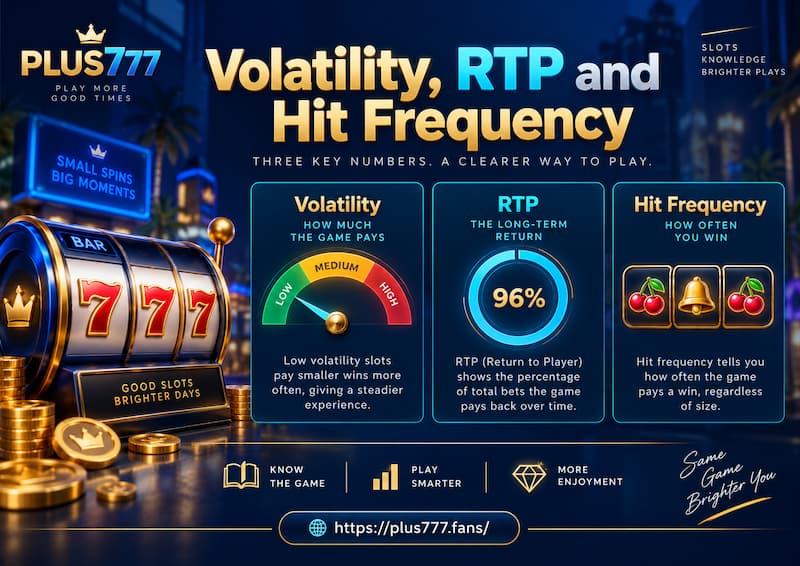
Volatility, RTP and Hit Frequency
Three Metrics With Different Roles
The simplest way to separate them is:
- Volatility describes how widely payouts can vary.
- RTP represents the theoretical percentage of wagers returned over a very large number of plays.
- Hit frequency describes how often a spin produces some form of payout.
A slot with a 96% RTP can still be highly volatile. Another game may also have a 96% RTP while delivering smaller payouts much more frequently.
The long-term mathematical return is similar on paper, but the path taken to reach it can feel completely different.
RTP Does Not Describe One Session
If a game lists 96% RTP, that does not mean every PHP 100 wagered produces PHP 96 back.
RTP is a theoretical payout figure calculated across an enormous number of game rounds. A short session can finish far above or far below that percentage.
Volatility has more influence over how uneven those short-term results may feel. This is why two slots with similar RTP figures can produce noticeably different experiences over 50 or 100 spins.
For practical comparison, RTP answers one question about the game’s long-run mathematics. Volatility answers another about how those results are distributed.
The Appeal of Low Volatility Slots for Casual Sessions
Many casual players are not looking for a session dominated by one possible jackpot-sized moment. They may simply want steady reel activity, manageable stakes and enough smaller returns to keep the game moving.

The Appeal of Low Volatility Slots for Casual Sessions
Less Dependence on One Large Payout
Consider two players starting with PHP 1,000 and betting PHP 10 per spin.
One chooses a low-volatility game. The other chooses a high-volatility game.
The first player may regularly receive modest returns that partially refill the balance. The second may experience longer losing sequences while waiting for a stronger combination or free spins bonus.
The starting money and stake are identical, yet the emotional pace is very different.
Low volatility does not remove losing streaks. It simply reduces the game’s dependence on occasional large events compared with a more aggressive mathematical model.
A Smoother Session Rhythm
Small returns can also make balance movement easier to follow.
Instead of seeing PHP 1,000 fall rapidly toward PHP 600 with few interruptions, the balance might move through a pattern such as PHP 1,000, PHP 970, PHP 1,010, PHP 960 and PHP 980.
That movement can feel less severe even when the long-term mathematical disadvantage remains unchanged.
For recreational play, this steadier rhythm is often the main attraction.
Low, Medium and High Volatility Compared
Volatility is easier to understand when the three common categories are viewed side by side.
Low Volatility
Low-volatility slots usually concentrate on regular smaller payouts.
They tend to suit sessions where frequent reel feedback and modest balance swings are preferred over rare large multipliers.
Medium Volatility
Medium volatility sits between the two extremes.
Payouts may appear less frequently than in a low-volatility game, but individual wins can have more weight. Many players find this balance comfortable because neither frequent small returns nor larger occasional payouts completely dominate the design.
High Volatility
High-volatility slots accept greater short-term variation.
Long stretches without significant returns can happen, while bonuses or strong combinations may account for a larger share of the game’s potential.
A player attracted to big multipliers may prefer this structure. Someone uncomfortable watching a balance move sharply in either direction may not.
Volatility is therefore better treated as a preference setting than a quality rating.
Finding Low Volatility Slots at PLUS777
When choosing games at PLUS777, the most useful information usually comes from the individual game rather than assumptions based on its theme, artwork or provider.
Check the Game Information
If volatility information is available, it may appear in the help menu, paytable, information screen or provider documentation.
A useful check includes:
- Volatility or variance rating
- RTP percentage
- Minimum and maximum bet
- Maximum win or multiplier
- Bonus feature structure
- Number of paylines or ways to win
These details give a much clearer picture than the design of the reels.
Theme Does Not Reveal Volatility
A bright fruit slot can be highly volatile. A dramatic mythology-themed game can be low or medium volatility.
Large jackpot graphics, bonus animations and expensive-looking visuals also tell very little about the underlying mathematics.
The same applies to providers. Two games released by the same studio can use completely different payout structures.
PHP Stakes and Session Pacing
Volatility should always be considered together with bet size.
A player betting PHP 5 per spin on a high-volatility game may experience smaller Peso swings than someone betting PHP 50 on a low-volatility title simply because the second player has ten times more money exposed on every spin.
Compare Games at Similar Stakes
For a cleaner comparison, keep the bet roughly equal.
If PHP 10 is used on both games, differences in payout behavior become easier to notice.
Increasing a bet from PHP 10 to PHP 100 does not turn a low-volatility slot into a high-volatility slot. The mathematical model remains the same. Only the Peso value attached to each outcome changes.
That distinction becomes important when managing a fixed session budget.
The Limits of Low Volatility
Frequent payouts can create a comfortable rhythm, but they should not be treated as a protective feature.
Frequent Hits Can Hide Gradual Losses
Imagine ten PHP 10 spins.
Several spins return PHP 4, PHP 6 or PHP 8. The screen may show frequent winning combinations, animations and sounds, yet the balance can still decline because many of those payouts are smaller than the original stake.
This is one reason hit frequency needs context.
A slot producing frequent results may feel generous while still slowly reducing the bankroll.
Smaller Upside Is Part of the Trade-Off
The smoother experience also tends to come with reduced emphasis on extreme multipliers.
Players specifically chasing rare 1,000x or larger outcomes may find low volatility too restrained. Medium- or high-volatility games often align better with that preference, although they can bring longer stretches without meaningful returns.
Neither approach is universally superior.
Matching Volatility to the Intended Session
Choosing between Low Volatility Slots and more aggressive alternatives becomes easier when the decision starts with the type of session being planned.
A practical approach is:
- Choose low volatility when frequent smaller payouts and steadier balance movement are preferred.
- Choose medium volatility when a mixture of regular activity and occasional larger outcomes feels more suitable.
- Choose high volatility when wider swings and longer payout gaps are acceptable in exchange for greater emphasis on larger potential wins.
Volatility should still be checked alongside RTP, hit frequency, betting range and the actual game rules.
For casual play, Low Volatility Slots have a clear strength: They can keep a session active without making every enjoyable moment dependent on one rare result. Keep the stake comfortable, decide on a time and money limit before playing and treat the game as entertainment rather than a way to generate income.